
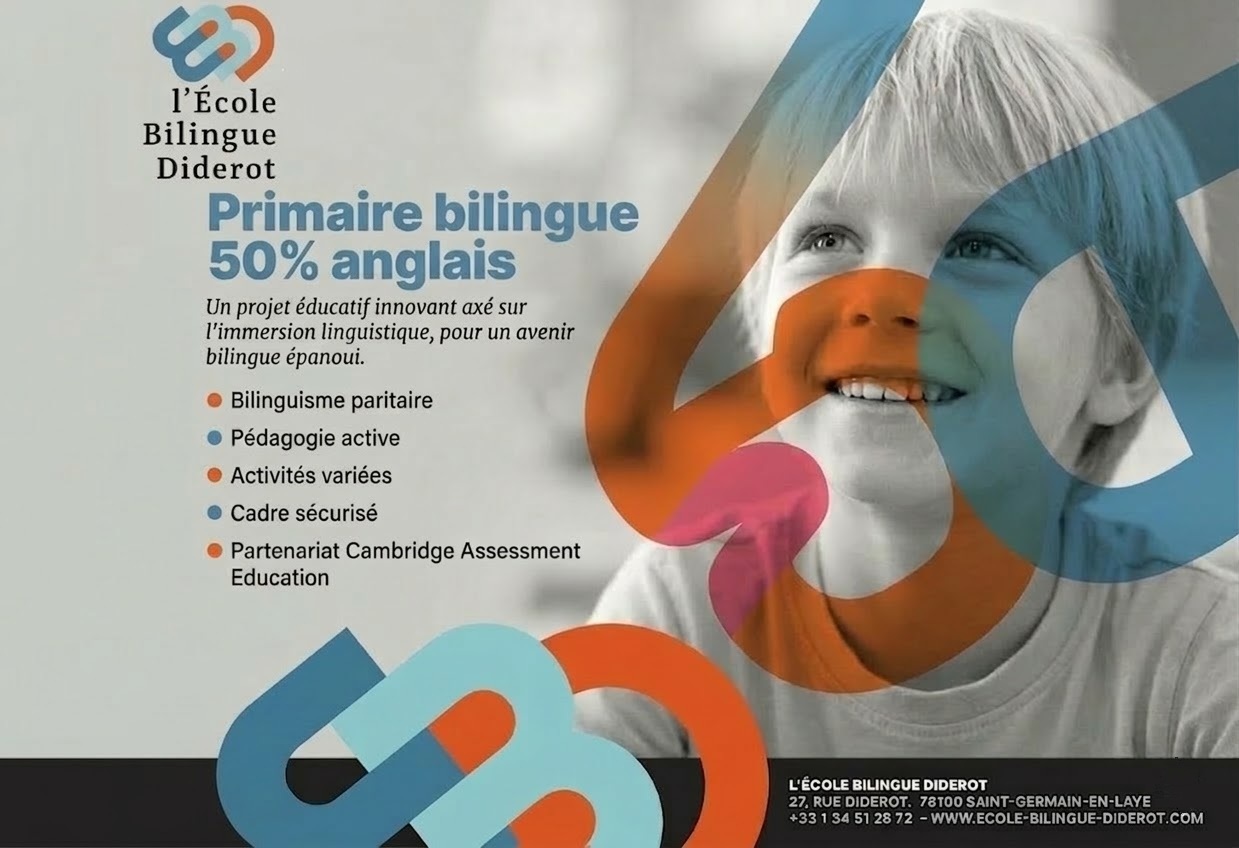
The Diderot Bilingual Primary School
Choosing a primary school is, first and foremost, an investment in the future. At our school, we have designed a unique bilingual curriculum to support each child from their entry into CP until the end of CM2.
Specifically, Diderot Bilingual Primary School is organized around 5 autonomous classes. It features a pedagogy that aims for students' personal development and cultural openness. Of course, we strictly adhere to the official curricula of the Ministry of National Education. We balance French academic rigor with real linguistic immersion.
The educational mission of Diderot Bilingual Primary School
An educational project based on balanced bilingualism
Since its opening, the Diderot Bilingual Primary School has developed an innovative concept. It has a clear objective: the success of each child during this crucial cycle. In reality, bilingualism is not just a subject; it is at the very heart of our pedagogy.
Half of the lessons are conducted in English, while the other half of the day is conducted in French. This joint effort facilitates cultural immersion through subjects such as science or arts. Students learn to express themselves fluently and naturally in both languages of instruction. They also study various educational works to spark their curiosity.
Two teachers per class, including a native-speaking teacher
Each class is led by a teaching duo. A native English speaker delivers instruction in English. Alongside, a Francophone teacher ensures complementary learning in French.
From lesson preparation to school trips, these professionals collaborate closely. They design coordinated learning sequences, which guarantees perfect methodological consistency.
At Diderot Bilingual Primary School, students become the true agents of their own learning. We observe a pragmatic approach where active engagement replaces the passive stance sometimes encountered in schools. Hands-on activities and experimentation give meaning to knowledge acquisition.
Our team fosters autonomy through various means. This includes the integration of digital tools to support students.
Levels and classes of the bilingual primary cycle
The preparatory course CP for mastering the basics of reading
This foundational year marks the beginning of reading acquisition for young students. Our bilingual primary school chooses an educational approach that adapts to the real needs of each child. To ensure smooth progress, our team caters to each individual's pace through small group workshops. These sessions are organized weekly based on the progress observed by teachers.
This pedagogical approach guarantees solid progress for every CP child. Additionally, regular assessments serve to validate the year's achievements. Thus, teachers support students with particular attention so they develop good habits and fluent reading.
CE1, or the first year of elementary school, consolidates fundamental knowledge
Students strengthen their independence in English through concrete communication situations. Teachers also prioritize research activities, as they promote active memorization of essential concepts. This work directly stimulates children's communicative fluency.
Verbal fluency is thus stimulated by daily cooperative projects within the classroom. This level prepares children to structure their thoughts while consolidating calculation mechanisms.
CE2, or the second year of elementary school, for deepening knowledge
Mid-cycle, students consolidate fundamental knowledge through regular practical exercises. Children in the CE2 class follow a rigorous learning path in accordance with the official curricula of the Ministry of National Education. Knowledge acquisition requires supportive repetition to firmly establish new concepts.
Thematic projects enliven each primary school day to encourage children's continuous engagement. Group cohesion encourages speaking up and builds confidence.
CM1 (the first year of middle primary) for developing synthesis skills
This first level of the consolidation cycle marks a transition towards greater conceptual abstraction. Students tackle more complex grammatical and mathematical concepts, in both French and English.
At Diderot Bilingual Primary School, inquiry-based learning is central to the curriculum. This fosters critical thinking and curiosity. Writing assignments intensify, and students learn to structure elaborate arguments. This year is dedicated to refining study methods.
CM2 (the final year of primary school) prepares students for secondary school
Preparation for secondary school entry begins with increased academic demands and greater independence. Written and oral expression in English becomes a fluid and natural daily practice.
Teachers accurately assess acquired skills to prepare students for the next stage of their academic journey. Families receive a progress report in February, followed by a comprehensive report in July. The administration emphasizes the importance of retaining these official documents, as they are necessary for future records.

Teaching Methods at Diderot Bilingual Primary School
Artistic and Cultural Workshops
The bilingual primary school favors action-based learning to firmly embed knowledge. Here, students can be observed actively engaging in class through concrete projects. In reality, artistic creation mobilizes theoretical knowledge in a playful way. During singing workshops, for example, children are naturally introduced to Anglophone and Francophone musical cultures.
Painting and manipulating materials give meaning to the concepts covered in class. This sensory approach strengthens the desire to explore the surrounding world. Furthermore, precision drawing develops the fine motor skills necessary for writing. Finally, English theater promotes public speaking fluency, which builds public confidence from a young age.
Science Projects and Extracurricular Activities
Students' natural curiosity finds a particular resonance in our approach to science. In work groups, they learn to formulate hypotheses and experiment with concrete solutions. Teachers then validate the results. They provide a clear summary for the entire class, which helps solidify the concepts learned. It can be observed that scientific challenges punctuate the school calendar throughout the seasons.
Anglo-Saxon culture, for its part, naturally integrates through these various achievements. A study trip often concludes the annual cycle in an immersive way. This school trip allows students to concretely discover other cultures. A unique opportunity for children to use what they've learned in class in real life.
Other Reasons to Choose Diderot School's Bilingual Primary Cycle
Secure Environment Near the Capital
Our primary school welcomes students in a warm and family-like atmosphere. Located in the heart of Saint-Germain-en-Laye, this human-sized institution features modern facilities for studying, playing, and physical activities. These modern infrastructures promote kindness at all times. The calm and secure environment of our institution has always reassured families.
Shared rules of conduct guide children's behavior effectively and respectfully. The internal regulations of Diderot Bilingual College protect the entire school community across all three levels (preschool, primary, and secondary).
A Qualified Teaching Team
Diderot Bilingual Primary School bases its teaching on high-level qualifications and rigorous academic standards. The fact is that the quality of our school relies primarily on the expertise of those who bring it to life. Teachers hold certifications from Cambridge Assessment Education. This institution brings together over 10,000 establishments worldwide, placing our educators at the heart of an international network of excellence.
The entire teaching team is committed to continuous improvement to evolve its practices in service of student success. This collaborative dynamic strengthens the school's cohesion and guarantees a high-quality bilingual learning environment.
An International Cultural Outlook
Bilingual education goes beyond simple language learning to become a true window to the world. Students are daily immersed in Anglo-Saxon cultures through literature, science, and history.
From primary school, early immersion in English fosters natural curiosity and great tolerance for differences. It's worth noting that our institution welcomes around fifty different nationalities. This unique mix helps each student understand the world around them from a young age.
Ultimately, our students don't just speak another language. They learn to live and interact with peers from all backgrounds. It's a true life lesson that goes beyond textbooks.
Relationship with Families and Follow-up
The synergy between school and home remains essential for a child's development in bilingual primary education. The academic year is divided into two distinct periods for our students:
- The first part runs from the start of the school year to the winter holidays.
- The second block concludes the curriculum in summer.
Throughout this journey, teachers conduct regular assessments. This method identifies what has been learned, and each result is communicated to parents.
In addition to individual skill booklets, communication is facilitated through the official website and social media of the Diderot Saint-Germain-en-Laye Bilingual School. Every instant message is handled with care by the teaching staff and the school administration.
Active Family Participation in School Life
To ensure effective monitoring and communication, parents receive progress reports in July. On this occasion, families are warmly invited to our open days as well as to their children's various shows and performances. Additionally, parents actively participate in supervising the end-of-year trip.
Before or after classes, the primary school teacher can also offer a meaningful discussion with parents. Both parties calmly discuss each student's progress.